
How to Price Interior Design Projects
Learn how to price your interior design projects with confidence, avoid common pricing mistakes, calculate your rates, and stop undercharging for your work!.
6/6/2026


The Pricing Problem Nobody Talks About Honestly
Most interior designers undercharge. Not slightly — significantly. The gap between what design services are worth and what most designers charge for them is one of the defining problems of the profession, and it is largely self-inflicted.
The causes are well understood: design education does not cover business; the profession attracts people who came to it through passion rather than commercial instinct; and there is a cultural discomfort with charging confidently for creative work that does not produce a physical object you can point to.
The consequences are just as well understood: burnout, resentment, clients who do not value the work, and businesses that never become financially stable. None of this is inevitable. Pricing is a learnable skill.
The Three Pricing Models — and When Each One Makes Sense
Before you can set the right price, you need to be using the right model. The three main approaches each have specific contexts where they work:
• Hourly rate: Appropriate for work with unpredictable scope — consultations, styling sessions, project management of client-procured furniture. The risk is that clients cannot budget accurately and may push back at invoices higher than expected. Hourly billing also implicitly penalises your efficiency: the faster you work, the less you earn.
• Flat project fee: Better for clearly scoped projects where you can estimate the work involved accurately. Both you and the client know exactly what the engagement costs. The risk is that scope creep erodes your margin. A clear, written scope of work with a defined revision process is non-negotiable with flat fees.
• Percentage of project budget: Common in larger residential and commercial projects. Typically 10–20% of the total construction and furnishing budget, depending on scope, market, and whether procurement is included. This model aligns your incentive with the client's investment — the more ambitious the project, the more you earn for managing it.
There is no universally correct pricing model. The right model is the one that fairly compensates you for the actual work involved and creates a clear, manageable relationship with the client.
How to Calculate What You Actually Need to Charge
Most designers who undercharge have never done this calculation. They have based their rates on what other designers they know are charging, or on what they think clients will pay — neither of which has anything to do with what they need to charge to run a sustainable business.
Start from the bottom up:
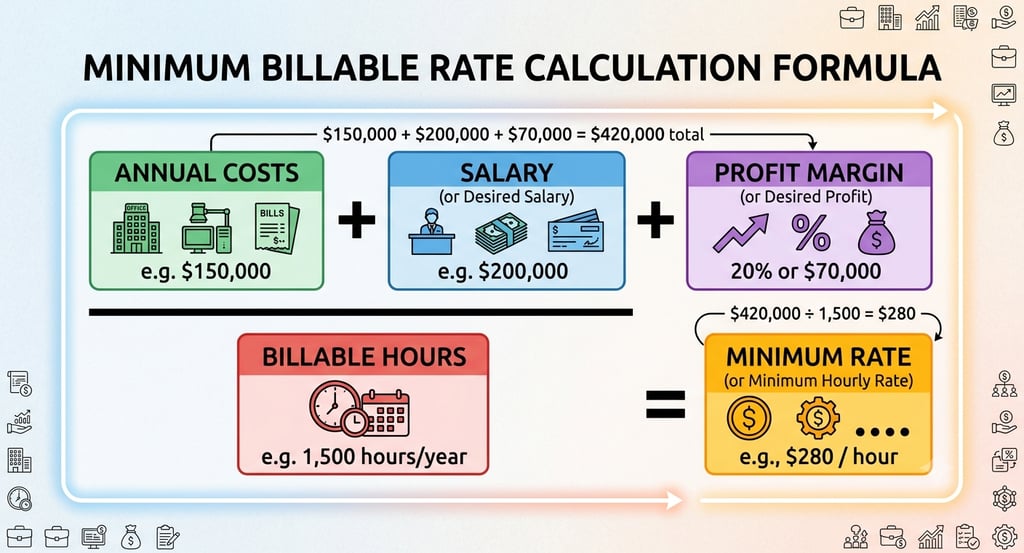
• Calculate your true annual costs: studio costs, software, insurance, professional memberships, marketing, accounting, equipment, and a realistic salary for yourself. Do not underestimate the salary — pay yourself what you would earn working for someone else.
• Estimate your billable hours: of the hours you work, how many are actually billable? Admin, marketing, new business, and professional development are all necessary but unchargeable. A realistic figure for a solo designer is 50–60% of total working hours.
• Add your profit margin: you need profit above salary to invest in the business, handle downturns, and build toward growth. A minimum of 20% profit margin is reasonable.
• Divide by billable hours: the result is your minimum viable hourly rate. If it is higher than you expected, the solution is not to lower your costs — it is to raise your rates.
The Psychology of Quoting High
The practical barrier to raising rates is almost always psychological rather than market-based. The fear that quoting a higher number will lose the client is rarely supported by actual evidence — it is a story designers tell themselves before they have tested it.
The market reality is that clients calibrate perceived quality to price. A low quote does not signal value — it signals uncertainty about your own worth, which signals uncertainty about the quality of your work. Many clients who would have paid significantly more have hired someone else because the low quote made them hesitant.
• Quote your real number. Not the number you think they will accept — the number that reflects the actual value and work involved.
• Pause after quoting. Do not fill the silence with justifications or apologies. State the fee, explain briefly what it covers, and wait.
• Know your walk-away point. The client who haggles aggressively is showing you who they will be to work with. Some of those negotiations are worth having. Many are not.
Protecting Your Fees: The Contract Conversations
Pricing is only part of the problem. Designers who quote correctly and then allow scope creep to erode their fees arrive at the same financial outcome. The contract is where pricing decisions are protected.
At minimum, a design contract should specify:
• Exactly what is included in the fee — and explicitly, what is not
• How many rounds of revisions are included and what constitutes a revision
• What triggers an additional fee and how that fee is calculated
• Payment milestones and late payment terms
• What happens if the project scope changes materially
The Client Who Cannot Afford You
Every designer encounters this. The client you would love to work with who simply cannot meet your rate. There are a few ways to handle it honestly:
• Offer a reduced-scope engagement: instead of full-service design, offer a single consultation and a written design brief they can implement themselves. Charge your normal rate for that scoped work.
• Refer them to a designer at an earlier career stage: a referral costs you nothing and builds goodwill in both directions.
• Be direct and kind: say that your rate for this project would be X, which may not work for their current budget, and that you would be glad to work together when that changes. This is more professional and more memorable than vague negotiation.
What not to do: discount your full service to meet a budget that was never viable for your practice. This creates a client relationship built on a financial foundation you will resent, and it serves neither party.
FAQ
Q: How do I raise my rates with existing clients?
A: Give them notice — ideally three to six months for ongoing relationships. Frame it as a planned adjustment rather than a reaction to anything specific. Long-term clients who value your work will accept a reasonable increase. Those who push back significantly are showing you something useful about the relationship.
Q: Should I include procurement markup in my fee structure?
A: Yes, if you are managing procurement. A standard markup of 10–20% on furniture and materials is normal practice and should be included in your written agreement. The alternative — passing items at cost and charging only for time — undervalues the curation and sourcing expertise that is often the most valuable thing a designer provides.
Chicspaces
Design faster without designing less.
Navigate
Get in touch
Support available Mon–Fri, 9–6 ET
Remote-first — serving designers worldwide